In Marburg, I live in a residence hall called Christian-Wolff-Haus. Christian-Wolff-Haus is really a little community of residence halls, located in Cappel, which is a suburb of Marburg. From my hall, it takes about 25 minutes to get to class or the inner city by bus. There is a bus stop right outside my hall and a bus comes about every twenty minutes during the weekdays.
One perk about German residence halls is that it is unusual to have to share a room. That is not the only difference between Phillips University- Marburg’s residence halls and the residence halls at the University of Wisconsin- Eau Claire though.
For example, there is no front desk in Christian-Wolff-Haus. That means one is unable to conveniently purchase pizzas or snacks and must have their own food. One must also have their own cooking supplies. There is no place to barrow or “check out” pots, pans and other useful cooking utensils like in the residence halls at UW-Eau Claire. There are kitchens on each wing of every floor in the residence halls in Marburg. It is common to cook for oneself and friends when not going to the cafeteria to eat.
The biggest differences between Marburg and UW-Eau Claire are the other residents, the atmosphere of the hall and that my hall has a Student Kneipe or student bar. The other residents on my floor seem to be nice, however not very outgoing. They generally greet each other, then close their doors and only come out of their rooms to use the kitchen, the bathroom or to leave the building. It is very different from the dorms at UW-Eau Claire where there seems to be a sense of community among the residents.
The people on my wing are also both male and female, which is typical for the residence halls here. Males and females do not have separate wings, showers or bathrooms.
There are also no resident assistants in the halls in Marburg. Here one is responsible for onself. To me it feels much more like I am living in an apartment complex rather than in a residence hall. I enjoy the fact that I can come and go as I please and do not have to answer to anyone.
A bar is a common establishment in residence halls in Marburg and most hall communities have at least one that students have access to. For a couple of euros, one can drink a beer and sit with friends in the comfort of their own hall. As an American, I found having a bar in a residence hall pretty strange. The bar in my hall is located on the ground floor which also features a laundry room, library and a room with a television.
The difference that has impacted me the most is that free internet is not provided in my hall. The Philips University-Marburg does provide free internet in some of its dorms, however not in all of them. When I moved into Christian-Wolff-Haus, I was told to ask around my floor and see if anyone would mind sharing their wireless internet with me. This is a common practice among the students in Marburg and I was told to expect to pay anywhere from five to ten euros per month for internet.
After several failed attempts at sharing the internet with neighbors, my friend took me to a store to buy a surf stick. Luckily, it ended up working. A surf stick is a little thing that one plus into one’s USB port and functions like a cell phone. Of course, I have to pay for this service and it is not cheap. It cost me 70 euros for the surf stick and the first month of internet. After that, I pay a monthly charge of 25 euros for the service.
My room is small but I enjoy having my own space. If you are curious, view the video attached to this entry to see what my room and what the rest of my wing looks like.
S.N.
Saturday, April 4, 2009

Monday, March 30, 2009
School
When people ask me what classes I am taking they are always surprised to find out that I am only enrolled in one class: a German language course. Everyone in the University of Wisconsin- Stevens Point program takes a series of three courses. The first two courses are language courses and the other is a German literature course. Each course is six weeks long with an exam at the end. The exam determines most of the grade a student receives and if the student is ready to move to a higher level course. I am in class weekdays from 9 a.m. until 12:50 p.m.
Class began on Tuesday, Feb. 24 and will go until April 7. Then we have a break until April 21, when we begin our second language course.
Before coming to Germany, all of the students in the program took placement tests. This is how the Philips University- Marburg evaluates ones language skills. From the results of the test, we were placed into six “stuffes” or levels. The first level is called the Grund Stuffe and it is designed for people who are just beginning to learn the German language. After the Grund Stuffe there are stuffes one through four. Stuffes five and six are combined. After completing Stuffe five/six one can take another exam to begin actual classes at Phillips University- Marburg.
Six students from our program tested into the first stuffe, eight tested into the second stuffe, six tested into the third stuffe and one person tested into the fourth stuffe. I am in the first stuffe.
At first the other students from the program and I were upset that we were placed in the first stuffe. The grammar seemed pretty basic and we all suffered a bit of a blow to our prides being placed in a lower level class. However, when we were given the choice to move, most of us decided to stay in the stuffe because it seemed like it would be a good review. The second stuffe already had two very full sections of students as well.
Though the pace is not always as quick as I would like it to be, it may have been a good choice for me to remain in the first stuffe. I feel as if the knowledge that I had already had about the German language is being cemented inside my head and extra practice is never a bad thing. Plus, through staying in the section, I have gotten to meet some interesting people.
Our class is comprised of 18 students who are all different nationalities. It consists of 12 people from America, two women from Russia, a man from Yemen, a woman from Iran, a man from Turkey and a man from Spain. It has been fun sharing information about our cultures with one another and learning together. However, it is not always easy to understand one another.
For example the second day of school the city buses went on strike. As students, city buses are our primary source of transportation, so it was a little chaotic. Determined not to miss my second day of class, I decided to walk to school. On my way, I saw Abdulghani, my classmate from Yemen, waiting for the bus. Since I did not know the necessary German vocabulary to explain a strike and he spoke no English, it was difficult it was to get my point across. Once Abdulghani understood that the buses were not coming, he called us a cab and all my effort and flailing was rewarded.
I have also made an unlikely friend in Fatemeh, the Iranian woman in our class. At first we sat next to each other because there were no other available seats. We shared answers and worked together on assignments and eventually this blossomed into a friendship. When I first saw Fatemeh I saw her headscarf, deduced that she was Muslim and because of this probably would not be friendly to an American. I am happy to say that I was wrong. Fatemeh jokes with everyone constantly and always seems to be smiling. We are interested in each other’s cultures and discuss them with each other almost daily. We also have plans to meet outside the classroom and discuss things more in depth. Believe it or not, Fatemeh also has Facebook!
Overall, I am happy with classes so far, though I am nervous about the rapidly approaching exams. I hope to pass into the next stuffe soon. Wish me luck!
S.N.
Image: Typical day in class
Class began on Tuesday, Feb. 24 and will go until April 7. Then we have a break until April 21, when we begin our second language course.
Before coming to Germany, all of the students in the program took placement tests. This is how the Philips University- Marburg evaluates ones language skills. From the results of the test, we were placed into six “stuffes” or levels. The first level is called the Grund Stuffe and it is designed for people who are just beginning to learn the German language. After the Grund Stuffe there are stuffes one through four. Stuffes five and six are combined. After completing Stuffe five/six one can take another exam to begin actual classes at Phillips University- Marburg.
Six students from our program tested into the first stuffe, eight tested into the second stuffe, six tested into the third stuffe and one person tested into the fourth stuffe. I am in the first stuffe.

At first the other students from the program and I were upset that we were placed in the first stuffe. The grammar seemed pretty basic and we all suffered a bit of a blow to our prides being placed in a lower level class. However, when we were given the choice to move, most of us decided to stay in the stuffe because it seemed like it would be a good review. The second stuffe already had two very full sections of students as well.
Though the pace is not always as quick as I would like it to be, it may have been a good choice for me to remain in the first stuffe. I feel as if the knowledge that I had already had about the German language is being cemented inside my head and extra practice is never a bad thing. Plus, through staying in the section, I have gotten to meet some interesting people.
Our class is comprised of 18 students who are all different nationalities. It consists of 12 people from America, two women from Russia, a man from Yemen, a woman from Iran, a man from Turkey and a man from Spain. It has been fun sharing information about our cultures with one another and learning together. However, it is not always easy to understand one another.
For example the second day of school the city buses went on strike. As students, city buses are our primary source of transportation, so it was a little chaotic. Determined not to miss my second day of class, I decided to walk to school. On my way, I saw Abdulghani, my classmate from Yemen, waiting for the bus. Since I did not know the necessary German vocabulary to explain a strike and he spoke no English, it was difficult it was to get my point across. Once Abdulghani understood that the buses were not coming, he called us a cab and all my effort and flailing was rewarded.
I have also made an unlikely friend in Fatemeh, the Iranian woman in our class. At first we sat next to each other because there were no other available seats. We shared answers and worked together on assignments and eventually this blossomed into a friendship. When I first saw Fatemeh I saw her headscarf, deduced that she was Muslim and because of this probably would not be friendly to an American. I am happy to say that I was wrong. Fatemeh jokes with everyone constantly and always seems to be smiling. We are interested in each other’s cultures and discuss them with each other almost daily. We also have plans to meet outside the classroom and discuss things more in depth. Believe it or not, Fatemeh also has Facebook!
Overall, I am happy with classes so far, though I am nervous about the rapidly approaching exams. I hope to pass into the next stuffe soon. Wish me luck!
S.N.
Image: Typical day in class
Sunday, March 29, 2009
Coming to Marburg
 On Sunday, Feb. 22, the group left Berlin on our voyage toward our impending studies. We stopped in a city called Eisenach for the night to visit the Wartburg Schloss. We also met our peer advisor, Cornelia, who would be helping us throughout our stay in Marburg. That night we filled out necessary paperwork and were given our room keys, as well as the news that most of us would not be receiving internet from the university. We would have to find the web on our own. I will explain that later.
The next morning we were dropped unceremoniously in front of our dorms and told to meet at somewhere called “Rudolph’s Platz” for dinner. This was the basis for the first week: We were given a time and a place and expected to be there. All 21 of us scurried around Marburg with our faces glued to our maps, hoping to catch the right bus.
Tuesday, Feb. 24, we began school in various buildings in the city.
Since coming to Marburg, I have felt a whirlwind of emotions from excitement, to homesickness to just plain culture shock. In the span of a few short weeks I have been thrust into the life of a German college student, which in many ways is quite different than the typical experience one has at the University of Wisconsin- Eau Claire. In the next few entries I will explain the class I am taking, my dorm room, the cafeteria as well as my feelings toward being a student in Germany. As always, feel free to leave comments and questions.
S.N.
Image of the group and Cornelia (front row, third from the right) when we registered with the city
Tuesday, March 17, 2009
Introducing Marburg
 This was not my first time visiting Marburg, so I knew a little bit about what to expect when we finished our tour in Berlin and made our way to the German state of Hessen on Monday, Feb. 24. I had spent two days last summer camping in a campground and exploring the city with a friend, so I instantly recognized some of Marburg's sites and buildings once we arrived.
However, I know that the average person probably has not heard of Marburg, Germany or has any idea what it may look like. I know that I achad not heard of Marburg until I became acquainted with the study abroad program that I am now a part of. To help combat this, I will try to describe the city to make it more tangible.
Marburg is located in Hessen, which is just about in the center of' Germany. Anthony Haywood, author of the Hesse section of Lonely Planet's "Germany," says that Marburg is about 90km north of one of Hessen's biggest cities, Frankfurt, and has a population of 79,000 people. Of this, the city of Marburg's official web site, http://www.marburg.de/, estimates that 18,000 of its residents are students.
According to Haywood, the Phillips University-Marburg was establised in 1527 and is the oldest Protestant university in Europe. The Brothers Grimm even studied there for a short time, he said.

"Other cities have a university, Marburg is a university,” says Marburg's web site. This is a perfect slogan for the city. Instead of having a campus, the university buildings are scattered throughout Marburg. For example, if the University of Wisconsin- Eau Claire's campus was set up in a similar manner, it would be like having the W.R. Davies Center on Waterstreet, Sutherland Hall by the Oakwood Mall and the Riverview Cafe somewhere in Altoona. Fortunately, Marburg has a good public transportation system and finding a bus is never difficult.

Marburg is also quite hilly. In fact, the city is divided between the "Oberstadt" and "Unterstadt." The Oberstadt is beautiful, containing cobble stone streets, historic homes, quaint-looking shops, the Landgrafenschloss (Landgraves' Castle) as well as the town square. The Unterstadt is more modern, but still lovely with the Lahn River flowing through it.

For more information about the city of Marburg visit Marburg's official Web site at http://www.marburg.de/en/24679.
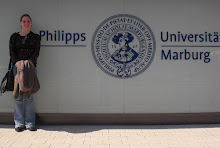
For more information about Philipps University-Marburg visit its official Web site at http://www.uni-marburg.de/index_html-en?set_language=en.

S.N.
First image: The city of Marburg from a bridge over the Lahn River.
Second image: I am posing on the highest point in the Oberstadt, next to the Landgrafenschloss.
Thursday, March 12, 2009
Flight to Germany/Entry Tour
About three weeks ago, after some tearful goodbyes, I found myself at Chicago’s O’Hare International Airport about to embark on my semester abroad in Marburg, Germany. With two overly stuffed suitcases in tow, I met the other 20 group members and our faculty advisor, Herr Barske and suddenly was whisked off to Deutschland for five months of schoolwork and exploration.
After ceremoniously eating an airport cheese burger and about eight hours in air, we landed in Frankfurt and stepped onto German soil. This, however, was short lived and soon we ended up in another plane bound for Berlin, where we spent our first week, Feb. 17-23, doing an entry tour. The tour would take us to many historical sites in Berlin and at each stop a student would give a short presentation, completely in German, to the group.
At the airport in Berlin we were met by a coach bus that would take us to the youth hostel where we were staying. The bus driver looked overwhelmed as he tried to stow all the bulging suitcases in the bus’s storage compartment for all the excited American students. Herr Barske explained to him that we were an exchange group. He still did not seem impressed. After about a twenty minute drive through the snowy streets, we unloaded at the Aletto Jugenhotel, where we stayed that week.
In the hostel, we were separated into rooms. I stayed in a room with four of my female classmates. The room itself was small, comprising of two sets of bunk beds, two single beds, two closets with small wooden shelves and cubbies and in true European style, two separate rooms containing the shower and toilet. It was also furnished with a small television set and a heater underneath the window (which unfortunately took us two days to learn how to operate).
Each morning we ate breakfast the hostel provided us and generally left the building by 8 to walk around the frozen city for 8 to 9 hours at a time. We visited many of the landmarks one associates with Berlin: the wall, Alexanderplatz, the Brandenburg Gate and even Pariser Platz, where Michael Jackson infamously held his baby out of a hotel window.
My favorite site was the site I gave a presentation on: Denkmal für die ermordeten Jueden Europas or The Holocaust Memorial, which is a memorial dedicated to the Jews who died during the Holocaust. We visited it Saturday, Feb. 21. The memorial is comprised of 2,711 gray concrete blocks called stelen, which are systematically placed in a grid pattern on a sloping hill. The stelen vary in height, the shortest being at the front of the monument at the top of the hill. As one walks further into the monument, and further down the incline, the stelen rise up, towering over one’s head menacingly, creating a feeling of entrapment. The maze-like quality of the memorial also adds to this feeling.

While preparing my speech in Eau Claire, I did not appreciate the memorial, but visiting the site made me realize how unique and special it was. It also made me realize how lucky I was to experience Berlin, and the rest of Germany, in such a hands on way.
After ceremoniously eating an airport cheese burger and about eight hours in air, we landed in Frankfurt and stepped onto German soil. This, however, was short lived and soon we ended up in another plane bound for Berlin, where we spent our first week, Feb. 17-23, doing an entry tour. The tour would take us to many historical sites in Berlin and at each stop a student would give a short presentation, completely in German, to the group.

At the airport in Berlin we were met by a coach bus that would take us to the youth hostel where we were staying. The bus driver looked overwhelmed as he tried to stow all the bulging suitcases in the bus’s storage compartment for all the excited American students. Herr Barske explained to him that we were an exchange group. He still did not seem impressed. After about a twenty minute drive through the snowy streets, we unloaded at the Aletto Jugenhotel, where we stayed that week.
In the hostel, we were separated into rooms. I stayed in a room with four of my female classmates. The room itself was small, comprising of two sets of bunk beds, two single beds, two closets with small wooden shelves and cubbies and in true European style, two separate rooms containing the shower and toilet. It was also furnished with a small television set and a heater underneath the window (which unfortunately took us two days to learn how to operate).
Each morning we ate breakfast the hostel provided us and generally left the building by 8 to walk around the frozen city for 8 to 9 hours at a time. We visited many of the landmarks one associates with Berlin: the wall, Alexanderplatz, the Brandenburg Gate and even Pariser Platz, where Michael Jackson infamously held his baby out of a hotel window.
My favorite site was the site I gave a presentation on: Denkmal für die ermordeten Jueden Europas or The Holocaust Memorial, which is a memorial dedicated to the Jews who died during the Holocaust. We visited it Saturday, Feb. 21. The memorial is comprised of 2,711 gray concrete blocks called stelen, which are systematically placed in a grid pattern on a sloping hill. The stelen vary in height, the shortest being at the front of the monument at the top of the hill. As one walks further into the monument, and further down the incline, the stelen rise up, towering over one’s head menacingly, creating a feeling of entrapment. The maze-like quality of the memorial also adds to this feeling.

I talked with one of my peers, Liz, as we navigated the snow covered field of stelen in the memorial. Liz interpreted the height of the stelen as a metaphor to how the rise of the Nazis had progressed. She noted also how when entering the memorial the stelen seemed unobtrusive and harmless but became more threatening and overpowering as one walked further inside.
While preparing my speech in Eau Claire, I did not appreciate the memorial, but visiting the site made me realize how unique and special it was. It also made me realize how lucky I was to experience Berlin, and the rest of Germany, in such a hands on way.
Another one of my favorite places was the Schloss Sanssouci, which we visited on the morning of Thursday, Feb. 19. Sanssouci, meaning “carefree” in French, was built by Prussian royalty as a sign of wealth and power as well as a summer getaway. Though we only visited the guest palace, it was very regal and impressive. Unfortunately, we were not allowed to take photos inside.
Our friendly tour guide took us from room to room, unlocking doors and explaining the palace to us slack-jawed Americans. We shuffled along behind her, trying to keep up in the over sized grey slippers guests were made to wear to prevent any damage to the floors.
The ceilings were adorned with massive paintings of Greek and roman gods and goddesses and the walls were adorned with bright silks or in ornate French rococo style designs plated in both gold and silver. Most of the rooms were nature themed with bright golden leaves and flowers.
My favorite room in the palace was decorated almost completely with seashells and semi-precious stones. They formed patterns on the walls and ceilings and between them gazed sea creatures both real and mythical. The room had five chandeliers and the floors below them were shiny marble. A corner of the room even featured a fountain.
I also really enjoyed the Sammlung Berggruen, which we visited on the afternoon of Feb. 20. The Sammlung Berggruen is an art museum that contained many works by Pablo Picasso. Through the audio guide I purchased, I was able to walk through the exhibit and learn about his “blue” and “red periods” while examining pieces of Picasso’s actual artwork. I soon discovered that each room at its own theme and began to enjoy trying to interpret the pieces before pushing play on my audio guide.
The entry tour was packed full of tourist sites, history and a lot of walking. As a group, we put in long hours exploring Berlin and at the end of each day I sunk into bed and cursed my aching knees and feet. I soon understood why we were earning one credit for the entry tour. Overall, it was a great experience though. I also found that the people of Berlin were generally very kind to visitors and forgave me for my lack of fluency and directions. They smiled, congratulated me for being an exchange student and wished me a good time in Germany. Because of their friendliness, I was never afraid to ask someone to help me find my way.
I could write a detailed description for each place we visited, however it would take too much time! Instead, below, I have included a list of all the places we visited. Feel free to post questions about any of the sites or research them on your own. Hopefully, I will also be adding more pictures of the entry tour as more of my classmates get Internet access here in Marburg, and we can exchange photos more easily. My camera broke the second day of the entry tour and I had to rely on the willingness of others to take photos for me. Bis spaeter!
S.N.
First image: A group photo taken by Herr Barske at Checkpoint Charlie
Second and third images: The Holocaust Memorial and Richard and I standing within it
Fourth image: Beth and I posing by a piece of the Berlin Wall
Places we visited as a group:
Berlin Wall
Scheunenviertel
Hackesche Höfe
Museumsinsel
Alexanderplatz
Nikolaiviertel
Reichstag
Brandenburg Gate
Pariser Platz
Berliner Dom
Schloss Sanssouci
Topographie des Terrors
Neue Synagoge
Schloss Charlottenburg
Kurfürstendamm
The Holocaust Memorial
Neue Nationalgalerie
Philharmonie
Gendarmenmarkt
Friedrickstraße
Berlin Wall
Scheunenviertel
Hackesche Höfe
Museumsinsel
Alexanderplatz
Nikolaiviertel
Reichstag
Brandenburg Gate
Pariser Platz
Berliner Dom
Schloss Sanssouci
Topographie des Terrors
Neue Synagoge
Schloss Charlottenburg
Kurfürstendamm
The Holocaust Memorial
Neue Nationalgalerie
Philharmonie
Gendarmenmarkt
Friedrickstraße
Subscribe to:
Posts (Atom)